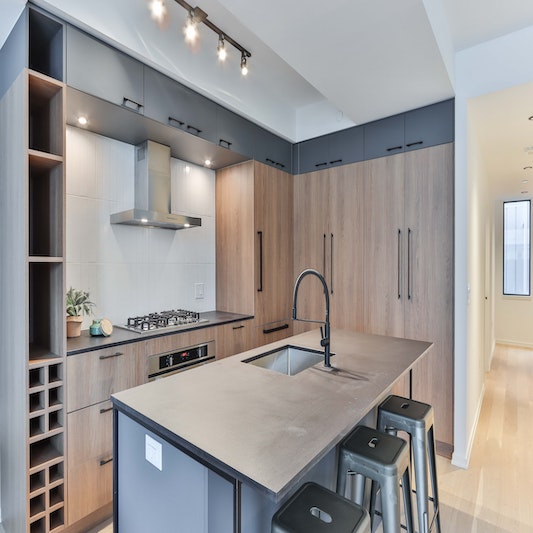
Every kitchen project in a flat starts with the same question: should the cabinets be made in a factory and installed (modular), built on site by a carpenter, or a mix of the two (semi-modular)? There's no single right answer. The choice depends on your layout, your society's rules, how long you can live with work in progress, and what you already have.
In short: a modular kitchen gives the most consistent finish, the least on-site cutting and noise, and parts that can be removed and replaced later. A carpenter-made kitchen gives the most freedom for unusual spaces, but its quality depends entirely on the carpenter and the supervision. Semi-modular sits in between. It's often the practical choice when a flat already has a granite platform and sink you want to keep.
The three options
Modular kitchen. Cabinets (boxes, shutters, drawers) are cut and edge-banded on machines in a factory to your measurements, then brought to site and assembled. Each unit is a separate module.
Carpenter-made kitchen. Boards are bought, cut and assembled in your flat by a carpenter, usually built directly into the space.
Semi-modular kitchen. A mix: typically an existing or site-built base (such as the builder-provided platform) with factory-made shutters, drawers and wall units fitted to it.
How they compare
| What matters | Modular | Semi-modular | Carpenter-made |
|---|---|---|---|
| Finish consistency | Machine cutting and edge banding give clean, repeatable edges | Factory parts are consistent; site-built parts depend on the workmanship | Depends on the carpenter's skill |
| Cutting, noise and dust on site | Lowest: most cutting happens in the factory | Moderate | Highest: all cutting happens in your flat |
| Time spent on site | Short installation once the modules are ready | In between | Longest: everything is built on site |
| Fitting odd shapes and old walls | Good, with careful measurement and filler panels | Good | Best: built to the exact space |
| Repairs and replacement | Individual modules, shutters and hardware can be replaced | Partly | Harder: units are often built in as one piece |
| Taking it with you if you move | Modules can be dismantled | Partly | Usually not practical |
| Quality checks | Can be checked at the factory before dispatch | Mixed | Checked only on site |
Which one suits your situation
You're furnishing a new flat in a high-rise society. Modular usually fits best. Societies limit noisy work to certain hours and ask for debris to be cleared daily (see our guide to society permissions for interior work). Factory-made modules mean far less cutting, noise and dust in the tower.
Your flat came with a granite platform and sink you're happy with. Semi-modular can make sense: keep the platform, and add factory-made shutters, drawers and wall units. Check the condition of the platform base first. A damp or uneven base will undermine new shutters.
Your kitchen is an unusual shape, or it's an older house with uneven walls. A carpenter-made kitchen, or modular with extra site finishing, can work around odd angles. Make sure someone experienced supervises the work.
You may move within a few years. Modular units can be dismantled and reused more easily than built-in carpentry, though they'll rarely fit a new kitchen without changes.
What matters more than the label
Whatever you choose, these decisions affect how long your kitchen lasts:
- Carcass material. Use water-resistant plywood, at least BWR for cabinets and BWP for the sink base. Our guide to MR vs BWR vs BWP plywood explains the grades.
- Hardware. Hinges, drawer channels and baskets take daily wear. Ask for the brand and model in writing, not just "soft-close".
- Edge banding and sealing. Every exposed edge should be sealed, especially around the sink.
- Shutter finish. Laminate, acrylic and PU paint differ in look, scratch resistance and upkeep. Pick based on how you cook and clean, not only on the showroom sample.
- Countertop and backsplash. Decide whether you're keeping the existing platform or replacing it, because that changes the whole plan.
- Chimney ducting. Check whether your kitchen has a provision for the chimney exhaust. A new opening in an external wall touches the building's facade, which needs your society's approval.
Questions to ask before you sign
- Which parts are factory-made, and which are built on site?
- What plywood grade, thickness and standard is each part made of?
- Which hardware brand and models are included?
- Are the countertop, sink, chimney, hob and plumbing work included, or priced separately?
- How long will installation take on site, and how will the work follow the society's hours?
- What's covered after installation, and who do you call if a hinge or channel fails?
Frequently asked questions
Is a modular kitchen always better than a carpenter-made one?
Not always. Modular gives more consistent quality and less site work, but a skilled, well-supervised carpenter can build an excellent kitchen, especially for awkward layouts.
Can I convert my existing kitchen to modular without breaking the platform?
Often yes. That's the semi-modular approach: keep the platform and fit modular shutters, drawers and wall units, provided the platform and its base are in good condition.
Which takes less time in my flat?
Modular usually means less time on site, because the units are made in a factory while the site waits. A carpenter-made kitchen is built entirely in your flat.
Planning a kitchen?
Book a free consultation with Huda Interior to compare options for your space. You choose the materials, hardware and finishes with your designer, and every item is shared with you for approval before anything is ordered. See our services for more.
Sources