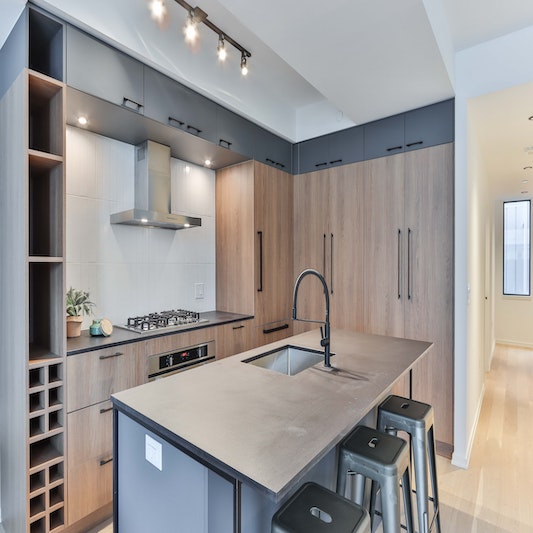
The shutters are the part of a modular kitchen you see and touch every day. Their finish decides how the kitchen looks, how much cleaning it needs, and a big share of its price. The three finishes most homeowners choose between are laminate, acrylic and PU paint.
In short: laminate is the most economical and the most forgiving: it hides scratches and fingerprints well, especially in matte and textured finishes. Acrylic gives a deep, mirror-like gloss but shows fine scratches and fingerprints. PU gives a smooth, seamless painted finish in almost any colour, at the highest price, and its quality depends on how well it was sprayed. Many kitchens mix them: a hard-wearing finish below, a glossier one above.
How they compare
| Laminate | Acrylic | PU paint | |
|---|---|---|---|
| What it is | A decorative sheet bonded to the board | A 1–2 mm glossy sheet bonded to the board | Several sprayed and cured coats of polyurethane paint |
| Look | Many colours, wood grains and textures; matte to gloss | Deep, mirror-like high gloss | Smooth and seamless, matte or gloss, almost any colour |
| Scratches | Highly scratch-resistant, especially matte | Fine scratches show over time | Good, but harder to repair at home |
| Fingerprints | Gloss shows them; matte and textured hide them | Shows fingerprints and smudges | Depends on the sheen; matte hides more |
| Moisture | Good, as long as the edges stay sealed | Good | Very good |
| Repairs | Damaged shutters are usually replaced | Light marks can sometimes be polished out | Needs professional respraying |
| Cost | Lowest | Higher | Highest |
Laminate: the practical default
Laminate is a printed decorative sheet pressed onto plywood or MDF. It comes in hundreds of colours, wood grains and textures, from super-matte to high gloss. It's the most economical of the three and stands up well to daily use, which is why it's the usual choice for budget and family kitchens.
Best for: busy kitchens, lower cabinets that take knocks, and anyone who doesn't want to wipe shutters every day.
Watch for: the edges. Moisture gets into a laminate shutter through badly sealed edges and makes them lift. Ask how the edges are finished. High-gloss laminate also looks less rich than acrylic or PU.
Acrylic: the high-gloss look
Acrylic is a thin, glossy sheet bonded to the board. It gives a deeper, more reflective shine than gloss laminate, and colour stays even across all the shutters. The trade-off is upkeep: acrylic shows fingerprints, smudges and, over time, fine scratches, especially in dark colours.
Best for: wall cabinets and tall units, where the shine brightens the kitchen and fewer hands touch the doors.
Watch for: cleaning. Use a soft cloth and a mild cleaner; abrasive scrubbers scratch it.
PU paint: the seamless finish
PU (polyurethane) shutters are sprayed with several coats of paint, each cured before the next. The result is a smooth surface with no visible grain or joint lines, in almost any colour, matte or gloss. It is the most expensive of the three, and the finish is only as good as the workshop that sprays it.
Best for: premium kitchens and custom colours, or handle-less designs where a seamless look matters.
Watch for: repairs. A chip or deep scratch needs professional respraying, so ask who will do it and how.
Mixing finishes
You don't have to pick one finish for the whole kitchen. Common combinations are:
- Matte laminate below, acrylic above: hard-wearing where hands and feet touch, glossy at eye level.
- One feature in PU, laminate elsewhere: a painted colour on the tall units or an island, with the economical finish everywhere else.
What else to check in a quote
The shutter finish is only part of the story. For each cabinet, a quote should also name:
- the board under the finish (BWR plywood for cabinets, BWP for the sink base; see our plywood guide);
- the edge finish on every shutter;
- the hardware: hinges, channels and handles, by brand and model.
Our quote comparison checklist helps you compare these line by line.
Frequently asked questions
Which kitchen shutter finish lasts longest?
Laminate is generally the most forgiving in daily use, especially in matte and textured finishes. Acrylic and PU last well too, but show wear differently: acrylic shows fine scratches, and PU chips need respraying.
Is acrylic better than laminate?
Not better, different. Acrylic looks glossier and richer; laminate is cheaper and hides wear better. Many kitchens use both.
How much more does PU cost?
It's the most expensive of the three, and prices vary widely with the workshop and finish. In our modular kitchen cost guide, acrylic and PU finishes fall in the premium range of about ₹2–2.6 lakh, against about ₹1.5 lakh for a standard laminate kitchen.
Which finish is easiest to clean?
Matte or textured laminate. Gloss finishes of any kind show fingerprints and need wiping more often.
Choosing your kitchen finish?
See our modular kitchen page for layouts and prices, or book a free consultation to see samples with a designer.
Sources